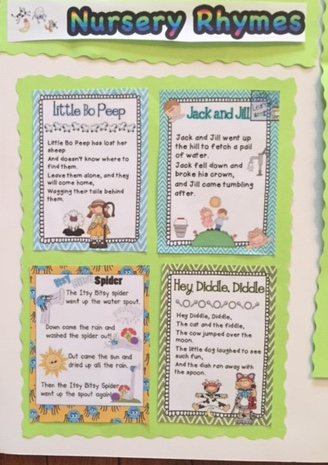
Dunst, C.
J., Meter, D., & Hamby, D. W. (2011). Relationship Between Young Children’s
Nursery Rhyme Experiences and Knowledge and Phonological and Print-Related Abilities.
Cell Review,4.
Harper, L. J. (2011). Nursery rhyme
knowledge and phonological awareness in preschool children. The Journal of
Language and Literacy Education [Online], 7(1), 65-78.
Lombardo, M. A. (january 2005). Rhythmic
Reading and Role Playing. Library
Media
Connection,23(4), 38-39. Retrieved February 24, 2016, from
http://connection.ebscohost.com/c/articles/16537464/rhythmic-reading-role-playing.
Research
and Development Staff. (2014). Nursery Rhymes and Phonemic Awareness. Sadlier-Oxford,3. Retrieved February 28, 2016, from
http://curriculuminstruction.parkridge.k12.nj.us/modules/groups/homepagefiles/gwp/2112102/2151697/File/Interesting
Places Docs/Nursery Rhymes and Phonemic Awareness.pdf.
Monday, February 22, 2016
Miriam
Lescaille
Module
3- Supporting Emergent Readers
Blog
3
Case
Study: Orlando’s Case Study
Student:
Orlando
Age:
7yrs.
Grade:
1st
Focus:
Comprehension
Possible
Strategies: Graphic Organizers; Repeated Reading; Comprehension Strategies
Orlando
is a 7 years old boy in 1st grade.Orlando is having difficulty recalling and remembering
simple facts from stories as well as answering questions pertaining to the
characters, setting, main idea, sequencing, and predicting, etc. Despite his
over all eagerness and happy disposition he is struggling when it comes to
comprehension especially when he reads independently.
The Following 3 Strategies Should Aid
Orlando and Help Him Achieve Better Comprehension:
1.
Comprehension Strategies:
Comprehension is the understanding of
what has been read.Comprehension
strategies are the techniques a proficient reader uses to gain meaning from a
text (The IRIS Center- Orlando Case Study). Some of the best Comprehension Strategies
include: Predicting, Summarizing, Retelling, Rereading, and Questioning.
Predicting: refers to guesses a student makes even
before they start to read the story such as looking at the pictures on the
cover, title, or just an educated guess.
This strategy will support Orlando by allowing him to get an idea of
what the story is about by just looking at the pictures on the cover or making
a guess about what he thinks the story is about and then see if his guess or
predictions were correct. We
search for and use the visual information that represents the language of the
text, for children that means following and understanding the story and also
getting information from pictures (Pinnell & Fountas).
Summarizing: helps the student identify the main
idea of a story. This strategy will support Orlando by helping him to read small
sections at a time from the story or one paragraph at a time and come up with
the main idea of what he has just read in one sentence. Students are asked to name the “who” or
“what” of the story, decide what the most important thing is about the “who” or
the “what,” and finally, say it in one sentence (The IRIS Center- Orlando Case
Study).
Retelling: allows the student to retell the story
right after he has heard it or read it. This strategy of “Retelling” will
support Orlando by helping him for example with the main idea, characters, main
events, and setting which are some of the skills that he is struggling with
according to his teacher.
Rereading: this helps the student to go back and
reread a part of the story in order to look for the answer or clarify something
they are not sure of. This
strategy will support Orlando because he would be able to go back into the
story what is called a “look back” to allow him to get more clarity or find the
answer. Rereading and revisiting
texts is very beneficial it expands vocabulary, helps them understand sentence
structure, and it increases their background knowledge (Pinnell & Fountas).
Questioning: This strategy allows the student to
answer the following questions from the reading: who, what, when, when, where,
and how. This strategy will
benefit Orlando because by him being able to answer the questions of who, what
when, where, and how from the story he will acquire more understanding and
comprehension of the text he has just read and be able to answer simple
comprehension questions.
The
above Comprehension Strategies and their components take time for the students
to begin to use on their own or with the help of the teacher, however over a
period of time they will benefit the student with the over all comprehension.
2.Graphic Organizers:
Graphic Organizers are simple diagrams
used to assist students at any grade level in organizing and recalling elements
from stories they have listened to or read (The IRIS Center- Orlando Case
Study).
Some examples of Graphic Organizers are:
Story Mapping, Literary Webs, and Venn Diagrams.Using the strategy of Graphic Organizers can help Orlando
with his comprehension skills.The
purpose of teaching students to use graphic organizers is to provide students
with metacognitive tools that they can (eventually) use on their own (Swanson
& De La Paz, 1998).
·Story Mapping: This Graphic Organizing skill can be
used for example, to help Orlando remember parts of the story like “who, what
and where” as well as having a visual representation.
·Venn Diagram: This Graphic Organizing skill helps
students see what stories have in common, how they are alike and what they
share, as well as what they are different in.This type of Graphic Organizer skill would help Orlando by
helping him compare and contrast some of the things the stories read have in
common as well as what they differ in and this will help him in his
comprehension and comparison between stories.
·Story Mapping: Sequencing: This Graphic Organizing skill
helps students to organize a story in order of events.They can draw pictures to represent the
order things happened in the story.This type of Graphic Organizer skill would help Orlando by having either
a visual representation or writing words to help him with his comprehension and
recall of the story and the order/sequencing in which the events of the story
took place.
·Literary Webs:This Graphic Organizing skill helps students to dissect the story and
take it apart and go from the whole to smaller parts in order to get a better
understanding of the story.Literary webs help students understand a story in terms of both the
whole and its parts (The IRIS Center- Orlando Case Study). This type of Graphic
Organizing skill would help Orlando by being able to start with the entire
story and then braking it up into smaller parts to improve his comprehension
and understanding of all the components of the story.
Orlando would benefit from all the
different types of Graphic Organizers because they will help him enhance his
comprehension and retelling and recalling of the stories read independently or
as a group for him to be able to remember the characters, setting, sequencing,
common threads within stories, as well as remembering details and creating a
visual and mental representation.Orlando would also benefit from the teacher modeling how to complete
each Graphic Organizer or Story Map over a period of time and then eventually
having him work on it independently or in small groups.In conclusion, overall research and the
readings I have done demonstrate that Graphic Organizers help and improve
students’ reading comprehension.
3.Repeated Reading:
Repeated Reading refers to reading a
familiar book or story over several times.Repeated reading has been shown to assist students reading
below grade level to make gains in fluency and reading comprehension skills
(Bos & Vaughn, 1998).This
strategy will help Orlando by giving him more of an opportunity to understand
and recall more of the details and have better reading comprehension.Moreover, children who had repeated
exposure to a story elaborated on and engaged in more interpretations of text
than children who did not (Doyle & Bramwell p.555). Repeated
Reading can be used with “Partner Reading” or in a “Group Repeated Reading set
up.
Partner
Reading: refers to when you pair two students and the student that is the more
skilled reader reads first to the student that has less reading skills to help
model for the student that needs the extra help. Morrow and Smith (1990) found that children read to in small
groups demonstrated better story comprehension than children read to in
whole-class settings. Orlando
would benefit from partner reading because he would have more of an opportunity
to ask questions for better comprehension, and feel more comfortable, and
achieve better understanding and comprehension of what is being heard.
Group
Repeated Reading: refers to when the
teacher first reads a line from a book first to show her students and then her
students follow along in their book, then the students repeat what the teacher
has read, and finally the students and the teacher repeat the line from the
book together. Orlando would benefit from repeated reading because he would
become more comfortable with the material, gain more comprehension, and build
vocabulary.
With the above Repeated Reading
Strategies one can also use “word walls, flashcards, and Reader’s Theater”.I feel that Orlando would benefit the most
from Reader’s Theater that consists of acting out the story, sequencing the
story and remembering the important characters.This would enable Orlando to have a better understanding and
internalize what he has read and in turn have better comprehension of the
characters, main idea, setting, and order of how things happened in the story
visually and mentally. Children will be eager to look at and perhaps retell or “reenact”
books that you have read or reread to them.This highly beneficial activity helps them internalize the
structure of stories, notice features of informational books, and practice the
language of books (Pinnell & Fountas).
“Literacy
ought to be one of the most joyful undertakings ever in a young child’s life.”
By Don Holdaway
Work
Cited
References
Doyle, B.
G., & Bramwell, W. (2006). Promoting Emergent Literacy and Social-Emotional
Learning Through Dialogic Reading. The Reading Teacher,59(6),
554-564.
Pinnell,
G. S., & Fountas, I. C. (2011). Literacy beginnings: A prekindergarten
handbook. Portsmouth, NH: Heinemann.
Welcome
to the IRIS Center. (n.d.). Retrieved February 22, 2016, from
http://iris.peabody.vanderbilt.edu/
Children’s
Story- “The Little Red Hen”
The
children’s story that I selected to develop a Graphic Organizer to be used with
the story to help Orlando identify the story’s main components is the story “The
Little Red Hen.”
The
Graphic Organizer that I want to create for Orlando for the story “The Little
Red Hen” will help Orlando answer the questions about setting (where),
characters (who), events (beginning, middle, end)/sequence of events (first,
next, last) and lesson learned. As well as use pictures/images/catchy phrases
that relate to the story, “The Little Red Hen” as part of my Graphic Organizer.
from
Mermelstein, L. (2006) Reading/Writing Connections in the K-2 Classroom focuses
on the components of a balanced literacy.
According to Mermelstein, L. (2006)
the components of a well balanced literacy program are:
·Shared Writing
·Read-Aloud
·Interactive Writing
·Shared Reading
·Writing Workshop (partnership and small group
work)
·Reading Workshop (partnership and small group
work)
·Word Study (which could include spelling,
phonics, phonemic awareness)
All the above components should be
linked across the reading and writing curriculum.
This article
gives a couple of different definitions for what “balanced literacy actually
means. However, the one that the
author of this article found to be the most accurate was by Spiegel. Most recently, Spiegel has defined
balance as a “decision making approach through which the teacher makes
thoughtful choices each day about the best way to help each child become a
better reader and writer.” (Spiegel, 1998).
As early literacy
educators we need to assess our students by observing them during reading and
writing and look for their strengths and weaknesses. Then we need to make notes, collect work samples, and keep
records in order for us to plan the best way to teach our students. Separate each component and find its
clarity, then, blur the lines and bring the components together so that you can
make thoughtful decisions about what to teach in each component and, most
important, how to connect them across reading and writing (Mermelstein, 2006).
Here is a brief description of each
of the components of balanced literacy as per my understanding after reading
this article:
·Shared Writing: is when the teacher models writing
as she is thinking, and the students are listening and watching her write.
·Read-Aloud: is when the teacher reads to her
students different types of books aloud.
·Interactive Writing: is when the teacher creates
a writing text with the help and cooperation of her students.
·Shared Reading: is when the teacher reads aloud
to her students and the students take part and participate in the reading as
well.
·Writing Workshops: is when the students work in
small groups or independently and the teacher works with the students in their
small groups or individually to improve their writing skills.
·Reading Workshop: is when the students work in
small groups or independently and the teacher works with the students in their
small groups or individually to improve their reading skills.
·Word Study: is when the teacher works with her
students either in small groups/independently/or as a class on their spelling,
phonics, etc.
After reading
this article, I have learned how important it is to incorporate the “components
of balanced literacy” (Shared Writing, Read-A-loud, Interactive Writing, Shared
Reading, Writing Workshop, Reading Workshop, Word Study) into my curriculum and
how by doing this I will plan better lessons, be a better teacher, and help my
students learn to become better and more skillful readers and writers.
Ever since I can remember I have loved to read. I grew up seeing my father and my mother always with a book, magazine or newspaper in their hands. Especially my father, whether he was going to the doctor sitting in the waiting room, waiting for my mother at the mall or just relaxing around the house, he always had something to read. He would get so involved in his reading especially history books which are his favorite that at times he didn’t even hear me when I was speaking to him. My mother would always say, “you know your dad, he’s reading, and when he’s reading he’s in another world and does not hear.”
Reading always came easy to me, and it is part of my life. I feel that I have my parents to thank for this because reading was such an important part of their life that they made sure that they instilled that love for reading in me as well. My mother read to me every day and every night before I went to sleep when I was a little girl. She was the person that taught me to read, and opened my mind to the fun, world of reading and imagination. I remember how excited my mom would get every night when I would pick a book for her to read, and she would climb into bed with me to read me the bedtime story of my choice. I remember what a great reader she was and still is and how her voice, body language, and expressions would change as she read the books to me and made each character come to life.
By the time I was three years old, I was reading by myself. My mother and father were thrilled. When my mother realized that I could read she was so excited she kept telling my father, “see, see, I taught her to read, and she learned because I read to her everyday.” She was overjoyed, the first night after we realized I could read and she came to read me my bedtime story and, I read to her the story instead. She had tears in her eyes, and that night she asked me to read the story to her over and over at least three times. I will never forget that night nor the story, “The Ugly Duckling,” or “El Patito Feo” which is the name of the story in Spanish my first language and the language I first learned to read in. After, I learned to read that story there was no stopping me, and my mother and I would take turns reading to each other at night before bed many times with my father also proudly listening. Almost every weekend my father would buy me a book or two and my mother or father would first read it to me and then shortly after I would read it to them.
When I was 9 years old, I came to the United States and I began to learn to read in English. It was an adjustment, but at the same time it was not too difficult for me. I had some issues with the pronunciation of some words but I learned to read quickly thanks to the effort of my teacher, Mrs. Higgins who saw that I had potential and worked very hard with me each day after school to teach me to read in English. My parents were so overwhelmed with pride when they would here me read in English. They would love to sit on the couch and ask me to read to them from my reading book, history book or library book. Now the tables had turned instead of them reading to me I was reading to them in English and they loved it! I think the fact that I was a good reader in Spanish and that I enjoyed reading made the learning to read in English a little easier, and more enjoyable for me.
Now, I am 51 years old and I still love to read. I’m a teacher to my Prek-4 class and I read to them everyday. I do my best to engage my students in literacy and instill in them the same joy and enthusiasm my parents instilled in me. I introduce my students to all types of books, vocabulary, and different reading materials. When I read to my students, I try my best to bring the books and stories to life and use all the tools I can to draw and engage my students. I also encourage my student’s parents to read to their child or children everyday, and explain to them how important literacy is to their child’s school success.
On a personal level, I still like to read every night before I go to bed and I still remember vividly and fondly my mother reading to me my favorite bed time story as a little girl, “El Patito Feo,” and I am blessed to have my parents with me and till this day be able to walk into my father’s office and still see him with a book in his hand engulfed in his reading, and my mother saying to me, “ he doesn’t hear you, he’s reading” which brings a smile to my face and warms my heart.